 Winnipeg,
pronounced WIHN uh pehg, is the capital of Manitoba, and one of Canada's largest cities.
It is Canada's main grain market and one of the nation's leading centers of culture,
finance, and trade. More than half of Manitoba's people live in the city. Winnipeg,
pronounced WIHN uh pehg, is the capital of Manitoba, and one of Canada's largest cities.
It is Canada's main grain market and one of the nation's leading centers of culture,
finance, and trade. More than half of Manitoba's people live in the city.
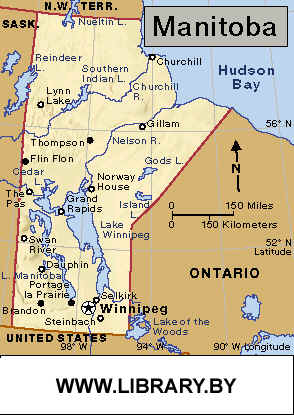
Winnipeg lies about 60 miles (97 kilometers) north of the Canadian-United States border
and almost midway between the Atlantic and Pacific oceans. Its central location makes the
city the chief transportation center linking eastern and western Canada. It is also a
principal distribution point for goods traveling west from eastern Canada. It has the
nickname Gateway to the West. It was named after Lake Winnipeg, about 40 miles (64
kilometers) to the north. The word Winnipeg comes from the Cree Indian words win-nipi,
meaning muddy water.
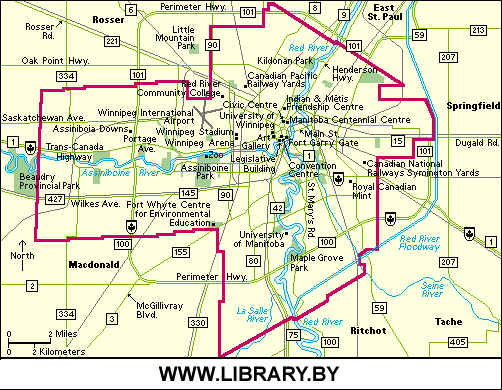
The city covers 179 square miles (464 square kilometers). It lies at the junction of the
Red and Assiniboine rivers.
Main Street, once an important settlers' trail, is Winnipeg's chief north-south street.
Portage Avenue, the beginning of the old overland route to Edmonton, Alberta, is the main
east-west street. The 33-story Toronto-Dominion Centre, Winnipeg's tallest structure,
rises 413 feet (126 meters) at Main and Portage. The city's chief public buildings are in
the nearby Civic Centre. The Manitoba Legislative Building stands on the Mall in a park on
the north bank of the Assiniboine River.
Winnipeg's metropolitan area covers 1,575 square miles (4,078 square kilometers). The
Winnipeg metropolitan area ranks as one of Canada's largest metropolitan areas in
population.
The people. More than 80 percent of Winnipeg's people were born in Canada, and most are of
mixed European ancestry. About one-third of the city's people have British ancestors. The
next largest ethnic groups are French people, Germans, and Ukrainians.
A large number of Indians and metis (people of mixed Indian and white ancestry) live in
Winnipeg. Most of the people in these groups moved to the city from rural areas. Many have
little or no education and find it hard to get jobs. They live in the city's poorest
sections. The Indian and Metis Friendship Centre provides a place for advice,
companionship, and recreation. But the low standard of living of many Indians and metis
remains a major problem in Winnipeg's downtown area.
 Economy. Winnipeg lies in a rich
grain-growing region, and the Winnipeg Commodity Exchange is Canada's major grain market.
The Canadian Wheat Board and many grain companies have their main offices in Winnipeg. The
Winnipeg Stock Exchange helps make the city a major financial center. Economy. Winnipeg lies in a rich
grain-growing region, and the Winnipeg Commodity Exchange is Canada's major grain market.
The Canadian Wheat Board and many grain companies have their main offices in Winnipeg. The
Winnipeg Stock Exchange helps make the city a major financial center.
The city is also an important transportation center. A number of major nationwide trucking
companies have their headquarters in Winnipeg. Canada's two transcontinental railroads and
a U.S. railroad serve the city. The Trans-Canada Highway and Manitoba's main highways pass
through Winnipeg. Winnipeg International Airport is one of Canada's busiest airports.
Important products made by Winnipeg area factories include aerospace equipment, clothing,
electronics, farm machinery, furniture, processed foods, and transportation equipment. The
Royal Canadian Mint in Winnipeg supplies all Canadian coins and also coins money for
foreign countries without mint facilities of their own.
Education. Winnipeg's public school system has about 255 elementary and
high schools. The city also has about 40 parochial and private schools. Local property
taxes provide the chief source of revenue for the public schools. The provincial
government also provides some funds for school expenses.
The University of Manitoba was founded in Winnipeg in 1877. Other schools of higher
education are the University of Winnipeg, in the downtown area; and Red River Community
College, which provides training in technical and office skills.
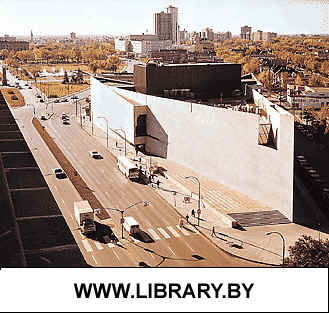 Cultural life. Winnipeg
is one of the chief cultural centers of Canada. The world-famous Royal Winnipeg Ballet,
the Winnipeg Symphony Orchestra, and the Manitoba Opera Association perform in the
Centennial Concert Hall. The hall is part of the Manitoba Centennial Centre, which also
includes the Manitoba Theatre Centre, the Museum of Man and Nature, and a planetarium. The
Winnipeg Art Gallery attracts many visitors. The city is also home to the Mennonite
Heritage Centre and the Ukrainian Museum of Canada. Cultural life. Winnipeg
is one of the chief cultural centers of Canada. The world-famous Royal Winnipeg Ballet,
the Winnipeg Symphony Orchestra, and the Manitoba Opera Association perform in the
Centennial Concert Hall. The hall is part of the Manitoba Centennial Centre, which also
includes the Manitoba Theatre Centre, the Museum of Man and Nature, and a planetarium. The
Winnipeg Art Gallery attracts many visitors. The city is also home to the Mennonite
Heritage Centre and the Ukrainian Museum of Canada.
A public library system operates branches throughout the city. The Winnipeg Centennial
Library is the main branch. The city has two daily newspapers, the Winnipeg Free Press and
The Winnipeg Sun. About 5 television stations and about 10 radio stations serve Winnipeg,
including one French-language television station and one multilanguage radio station.
Winnipeg has about 900 parks, squares, and athletic fields. Assiniboine Park, covering 375
acres (152 hectares), is the largest park. It includes beautiful gardens and a zoo. The
Assiniboine Forest, a 692-acre (280-hectare) nature preserve, lies south of the park.
TheWinnipeg Blue Bombers of the Canadian Football League play their home games in Winnipeg
Stadium.
Ross House, western Canada's first post office, is in downtown Winnipeg. It opened in
1855. Lower Fort Garry National Historic Park, north of Winnipeg, has the only stone
fur-trading post still standing in North America. The post dates from the 1830's.
Government. Winnipeg has a mayor-council government. The voters in each of Winnipeg's 15
wards (voting areas) elect one councilor to the city council. The councilors serve
three-year terms. The voters also elect a mayor to a three-year term as administrative
head of the government. A five-member board of commissioners, including a chief
commissioner, supervises various departments of the government. Property taxes provide
about two-thirds of Winnipeg's revenue.
History. The Assiniboine and Cree Indians lived in what is now the Winnipeg area before
the first whites arrived. In 1738, Sieur de La Verendrye, a French-Canadian fur trader,
became the first white person to reach what is now Winnipeg. He built Fort Rouge at the
junction of the Red and Assiniboine rivers and traded for furs with the Indians.
During the early 1800's, the Winnipeg area became the center of fur-trade rivalry between
the North West Company and the Hudson's Bay Company. In 1812, Scottish and Irish farmers
set up the area's first permanent settlement along the Red River (see MANITOBA [The Red
River Colony]). The Hudson's Bay Company absorbed its chief rival in 1821. That year, the
company enlarged Fort Gibraltar, a post at the site of present-day Winnipeg, and renamed
it Fort Garry. It rebuilt the fort in 1835 and called it Upper Fort Garry. A trading post
north of Winnipeg was known as Lower Fort Garry. Upper Fort Garry became the center of the
Red River settlement.
In 1870, Manitoba entered the Dominion of Canada. The Red River settlement was renamed
Winnipeg that same year, and it became the capital of the new province. It was
incorporated as a city in 1873. By then, it had about 1,900 people. In 1878, Manitoba's
first railroad linked Winnipeg and St. Paul, Minn. The Canadian Pacific Railway (now CP
Rail) connected Winnipeg with eastern Canada in 1881. The government's offer of free land
in western Canada helped Winnipeg's population grow during the late 1800's.
During the early 1900's, large numbers of Europeans settled in Winnipeg. Industry grew
rapidly in the city during this period, and Winnipeg became the manufacturing center of
western Canada. The opening of the Panama Canal in 1914 slowed Winnipeg's expansion.
Companies in eastern Canada could now send their products to the West more cheaply by ship
through the canal than by railroad. Winnipeg's economy continued to suffer during the
Great Depression of the 1930's.
During World War II (1939-1945), sharp increases in the demand for livestock, lumber,
metals, and wheat brought prosperity back to Winnipeg. Between 1946 and 1950, about 200
industries began in Winnipeg. The city's population fell during the 1960's, partly because
of a trend toward suburban living.
In 1960, the Manitoba legislature established the Metropolitan Corporation of Greater
Winnipeg to administer a number of services for Winnipeg and 11 of its suburbs. These
services included planning and zoning, public transportation, and water supply. Each
municipality in the corporation also had its own governing council to administer local
affairs.
In 1971, the Manitoba legislature combined Winnipeg and the suburbs into one municipality,
the unified city of Winnipeg. The merger, which took effect on Jan. 1, 1972, greatly
increased the city's area and population.
A downtown building boom began in the 1960's and 1970's. Tall apartment and office
buildings and hotels replaced many old structures. New construction included the Winnipeg
Convention Centre, which opened in 1975, and a system of enclosed walkways above the
streets.
In 1981, the city, provincial, and federal governments launched the Winnipeg Core Area
Initiative. Through this program, the three governments provided funds to improve
education, social services, and economic development in a 10-square-mile
(26-square-kilometer) area of the inner city. The Core Area Initiative included renovation
of historic office and warehouse buildings in the downtown Exchange district, and
construction of a shopping and residential complex on Portage Avenue. The city,
provincial, and federal governments also formed a public corporation to develop a 56-acre
(23-hectare) historic area called the Forks. This area, which is located at the junction
of the Assiniboine and Red rivers, includes many sites from Winnipeg's early days as a
fur-trading center. The Forks opened to tourists in 1990, but development was to continue
for many years.
Contributor: John S. Brierley, Ph.D., Prof. of Geography, Univ. of
Manitoba.
Facts in brief about
Winnepeg
Population: 618,477. Metropolitan area population --667,209.
Area: 179 sq. mi. (464 sq. km). Metropolitan area --1,575 sq. mi. (4,078 sq. km).
Altitude: 784 ft. (239 m) above sea level.
Climate: Average temperature --January, -2 degrees F (-19 degrees C); July, 68 degrees F
(20 degrees C). Average annual precipitation (rainfall, melted snow, and other forms of
moisture)--21 inches (53 centimeters). For the monthly weather in Winnipeg, see MANITOBA
(Climate) .
Government: Mayor-council. Terms --3 years for the mayor and 15 councillors.
Founded: 1870. Incorporated as a city in 1873.
|


