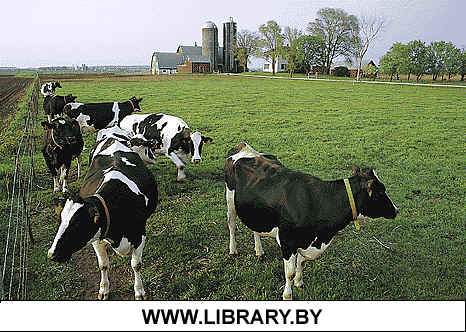
 Wisconsin is a
Midwestern state of the United States that has long been famous for its dairy products.
Thousands of herds of milk cows graze on the rich, green pastures of the rolling Wisconsin
countryside. They make Wisconsin one of the nation's leading milk producers. The state
also produces about a third of the country's cheese and about a fourth of its butter. This
tremendous output of dairy products has earned Wisconsin the title of America's Dairyland.
The processing of milk into butter, cheese, and other dairy products is a leading
manufacturing activity in Wisconsin. Manufacturing is more important to Wisconsin's
economy than it is to the economies of most other states.
Wisconsin is one of the leading states in the manufacture of machinery, food products, and
paper products. The cities of southeastern Wisconsin produce construction cranes, engines,
machine tools, and other machinery. Besides dairy products, the state's food products
include canned and frozen vegetables, sausages, and beer. Northern Wisconsin has many
paper mills.
Most of Wisconsin's workers are employed in service industries, which include education,
finance, health care, and trade. The state's public university system is one of the
largest in the nation. Milwaukee ranks as one of the Midwest's chief financial centers.
Madison, Milwaukee, and La Crosse have major medical centers. Ports along Lake Michigan
and Lake Superior handle both foreign and domestic trade.
The natural beauty and recreational resources of Wisconsin attract millions of vacationers
every year. Wisconsin has about 15,000 lakes to delight swimmers, fishing enthusiasts, and
boaters. Hikers and horseback riders follow paths through the deep, cool north woods of
Wisconsin. Hunters shoot game animals in the forests and fields. In winter, sports fans
enjoy skiing, tobogganing, and iceboating.
 Wisconsin has won fame as one of the nation's most
progressive states. An important reform movement called Progressivism started in Wisconsin
during the early 1900's. The state began many educational, social, political, and economic
reforms that were later adopted by other states and the federal government. Many of these
reforms were sponsored by the La Follettes, one of the most famous families in American
political history.
Wisconsin led the way to direct primary elections, regulation of public utilities and
railroads, pensions for teachers, minimum-wage laws, and workers' compensation. Wisconsin
also was the first state to end the death penalty for crime.
The first schools for training rural teachers were established in Wisconsin, as were the
first vocational schools. The University of Wisconsin was one of the first universities to
offer correspondence courses. The nation's first kindergarten began in Wisconsin.
Wisconsin established the first library for state legislators.
Wisconsin has been a leader in the development of farmers' institutes and cooperatives,
dairy farmers' associations, and cheese-making federations. It also played a major role in
the founding of the Republican Party. One of the nation's first hydroelectric plants was
installed in Wisconsin. Wisconsin was the first state to adopt the number system for
marking highways. It passed the first law requiring safety belts in all new automobiles
bought in the state.
Wisconsin is an Indian word. It has several possible meanings, including gathering of the
waters, wild rice country, and home land. Wisconsin has been nicknamed the Badger State,
and its people are known as Badgers. This nickname was first used for Wisconsin lead
miners in the 1820's. Some of these miners lived in caves that they dug out of the
hillsides. They reminded people of badgers burrowing holes in the ground.
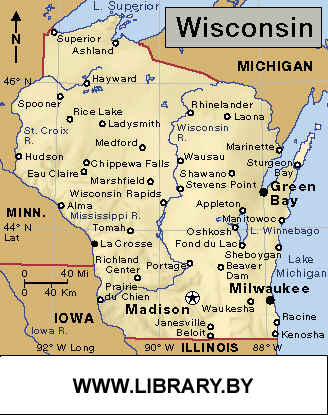
Madison is the capital of Wisconsin. Milwaukee is the state's largest city.
People
Population. The 1990 United States census reported that Wisconsin had 4,906,745 people.
The population had increased 41/2 percent over the 1980 figure, 4,705,642. According to
the 1990 census, Wisconsin ranks 16th in population among the 50 states.
About two-thirds of the people live in urban areas. Almost a third live in the
metropolitan area of Milwaukee-Waukesha. There are 10 metropolitan areas that lie entirely
within the state. One other area, La Crosse, extends partly into Minnesota. Two of
Minnesota's metropolitan areas, Minneapolis-St. Paul and Duluth-Superior, extend into
Wisconsin. For the populations of these metropolitan areas, see the Index to the Wisconsin
political map.
Milwaukee, Wisconsin's largest city, is a leading center of manufacturing. Madison, the
state's capital, is Wisconsin's second largest city. It is home to the oldest and largest
campus of the University of Wisconsin. Other large Wisconsin cities are Green Bay, Racine,
and Kenosha. All are important manufacturing and shipping centers.
 About 97 of every 100 Wisconsinites
were born in the United States. More than half of the state's people are of German
descent. Milwaukee is a leading U.S. center of German-American culture. Wisconsin's other
large population groups include people of Irish, Polish, and English descent. About 5
percent of the state's people are African Americans.
Schools. Michael Frank, a newspaper editor in Southport (now Kenosha), led the movement
for free schools in Wisconsin. In 1845, he started Wisconsin's first public school. The
state Constitution, adopted in 1848, provided free schooling for all children in Wisconsin
between the ages of 4 and 20. In 1856, Margaretha Meyer Schurz opened the first
kindergarten in the United States in Watertown.
A 1911 Wisconsin law required all cities and towns in the state with populations of 5,000
or more to establish vocational schools. This was the first law of its kind in the United
States. Today, the Milwaukee Vocational School ranks as one of the largest trade schools
in the United States. In 1891, the University of Wisconsin established one of the first
correspondence schools in the United States.
Wisconsin's public schools are directed by a nonpartisan superintendent of public
instruction, who is elected to a four-year term. School attendance in the state is
required of children from ages 6 through 18. For the number of students and teachers in
Wisconsin.
Libraries. Wisconsin has about 380 public libraries, all of which take part in the state's
17 regional library systems. Wisconsin also has many college and university libraries and
other special libraries serving industry, institutions, and government. The State Law
Library was founded in Madison in 1836. State legislation authorizing free public
libraries was passed in 1872. A reference library for legislators is in the state Capitol.
It was founded in 1901 and was the first of its kind in the nation.
Today, the State Department of Public Instruction is responsible for the promotion and
development of both public and school library service in the state. The largest libraries
in the state are the Milwaukee Public Library and the University of Wisconsin Library in
Madison. Each has over 2 million books. The State Historical Society in Madison has one of
the nation's largest collections of books, newspapers, and manuscripts on United States
history.
Museums. The Milwaukee Public Museum is Wisconsin's largest museum. It is among the finest
natural history museums in the nation. The State Historical Society in Madison features
exhibits on the state's history. Wisconsin has some highly specialized museums, including
the Dard Hunter Paper Museum in Appleton; the Circus World Museum in Baraboo; the Farm and
Craft Museum in Cassville; and the Experimental Aircraft Association Museum in Oshkosh.
Old World Wisconsin, near Eagle, honors the ethnic groups that settled the state. The
Leigh Yawkey Woodson Art Museum, in Wausau, is known for its bird collection. Wisconsin
has art museums in Beloit, Madison, Milwaukee, Oshkosh, and on university campuses.
Visitor's guide
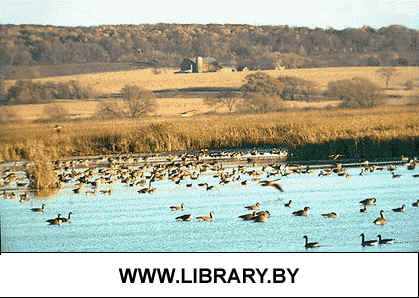 Wisconsin's natural beauty has made
it a favorite vacation spot with tourists in all seasons. Millions of people visit the
state each year. Vacationers enjoy Wisconsin's sparkling lakes, rolling hills, quiet
valleys, and cool, pine-scented breezes. In spring and summer, hikers and cyclists enjoy
the countryside. The winters are ideal for cross-country skiing, skating, and
snowmobiling. The state is host to the Birkebeiner, North America's largest cross-country
ski race. The World Championship Snowmobile Derby takes place at Eagle River.
The city of Milwaukee offers a wide range of ethnic and music festivals. Summerfest, a
music festival, offers live music of every type. Summer theaters in the state offer plays
of all types, from off-Broadway to Shakespeare. During late July and early August, Wittman
Field in Oshkosh becomes the busiest airport in the United States, as the Experimental
Aircraft Association holds its annual Fly-In.
Door County peninsula, in the northeast part of the state, features about 250 miles (400
kilometers) of Lake Michigan shoreline. Wisconsin Dells, another popular vacation spot,
offers scenic boat rides and large water theme parks. Many annual events celebrate the
state's rich ethnic heritage and diversity.
Land and climate
Wisconsin is a land of rolling hills, ridges, fertile plains and valleys, and beautiful
lakes. A series of glaciers that began about a million years ago traveled over most of
present-day Wisconsin. The glaciers scraped hilltops, filled in valleys, and changed most
of the surface. As the ice melted and the glaciers wasted away, they left thick deposits
of earth materials. These deposits blocked drainage of the water, causing lakes, marshes,
and streams with falls and rapids. Glaciers do not appear to have touched southwestern
Wisconsin. Much of this portion of the state is rough, with steep-sided ridges and deep
valleys.
Land regions. Wisconsin has five major land regions. They are (1) the Lake Superior
Lowland, (2) the Northern Highland, or Superior Upland, (3) the Central Plain, (4) the
Western Upland, and (5) the Eastern Ridges and Lowlands, or Great Lakes Plains.
The Lake Superior Lowland is a flat plain that slopes gently upward toward the south from
Lake Superior. The plain ends from 5 to 20 miles (8 to 32 kilometers) inland at a steep
cliff.
The Northern Highland covers most of northern Wisconsin. It slopes gradually downward
toward the south. The region is a favorite vacationland because of its heavily forested
hills and hundreds of small lakes. Timms Hill, the state's highest point, rises 1,952 feet
(595 meters) above sea level in Price County.
The Central Plain curves across the central part of the state. Glaciers covered the
eastern and northwestern parts of this region. Much of the southern portion was not
touched by glaciers. In this southern portion, the Wisconsin River has carved the scenic
gorge called the Wisconsin Dells.
The Western Upland is one of the most attractive parts of Wisconsin. Steep slopes and
winding ridges, untouched by glaciers, rise in the southwestern part of the region.
Limestone and sandstone bluffs of breathtaking beauty stand along the Mississippi River.
The Eastern Ridges and Lowlands region extends from the Green Bay area southward to
Illinois. Gently rolling plains of glacial material partly cover limestone ridges that run
from north to south. This region is the richest agricultural section of Wisconsin. It has
the state's largest areas of high-grade soil, and its longest growing season.
Shoreline of Wisconsin extends 381 miles (613 kilometers) along Lake Michigan and 292
miles (470 kilometers) along Lake Superior. Bluffs and sandy beaches line the Lake
Michigan shore. Lake Superior's shoreline also has sandy beaches, but fewer rugged bluffs.
Wisconsin's largest ports include Ashland, Green Bay, Manitowoc, Milwaukee, and Superior.
Rivers, waterfalls, and lakes. An east-west divide cuts across northern Wisconsin. This
ridge of land separates short rivers that enter Lake Superior--such as the Bad, Montreal,
and Nemadji rivers--from the longer rivers that flow southward--such as the Flambeau and
St. Croix. A north-south divide runs down the eastern third of the state. West of this
divide, the rivers flow into the Mississippi. These rivers include the Black, Chippewa, La
Crosse, St. Croix, and Wisconsin. Streams east of the divide empty into Lake Michigan
directly or through Green Bay. These rivers include the Fox, Menominee, Milwaukee, Oconto,
and Peshtigo.
Wisconsin has hundreds of waterfalls. The highest is Big Manitou Falls in Pattison State
Park, in the extreme northwest. The falls, located on the Black River, drop more than 165
feet (50 meters).
Wisconsin has about 15,000 lakes. Lake Winnebago, the state's largest lake, covers 215
square miles (557 square kilometers). Green Lake, more than 237 feet (72 meters) deep, is
the deepest lake. Other large natural lakes include Butte des Morts, Geneva, Koshkonong,
Mendota, Pepin, Poygan, Puckaway, and Shawano. The chief artificially created lakes
include Beaver Dam, Castle Rock, Chippewa, Du Bay, Flambeau, Petenwell, Wisconsin, and
Wissota.
Plant and animal life. Forests cover almost half of Wisconsin. The state's softwood trees
include balsam fir, hemlock, pine, spruce, tamarack, and white cedar. Hardwood trees
include ash, aspen, basswood, elm, maple, oak, and yellow birch.
Blueberries, huckleberries, Juneberries, wild black currants, and other shrubs grow in
parts of northern and central Wisconsin. Pink trailing arbutus blossoms over rocks and
under trees in early spring. More than 20 kinds of violets bloom in all sections. In
autumn, the Wisconsin countryside is a blaze of color. The red and gold tree leaves blend
with brilliant asters, fireweeds, and goldenrods.
Bears, coyotes, deer, and foxes are found in Wisconsin's deep forests. Fur-bearing animals
include beavers and muskrats. Badgers, gophers, and prairie mice scurry through the
underbrush. Other animals found in Wisconsin include chipmunks, porcupines, raccoons, and
woodchucks.
Wisconsin's northern lakes and streams abound with such game fish as bass, muskellunge,
pickerel, pike, sturgeon, and trout. Game birds include ducks, geese, jacksnipes,
partridges, pheasants, ruffed grouse, and woodcocks. Loons and other waterfowl breed on
the northern lakes. The marshes shelter bitterns, black terns, and coots. Other birds that
are found in Wisconsin include chickadees, nuthatches, robins, snipes, swallows, warblers,
and wrens.
Climate. Wisconsin usually has warm summers and long, severe winters. Lake Michigan and
Lake Superior make summers somewhat cooler and winters slightly milder along the shores.
Average January temperatures range from 12 °F (-11 °C) in the northwest to 22 °F (-6 °C)
in the southeast. Danbury recorded the state's lowest temperature, -54 °F (-48 °C), on
Jan. 24, 1922. Average July temperatures range from 69 °F (21 °C) in the north to 73 °F
(23 °C) in the south. The state's record high, 114 °F (46 °C), was set at Wisconsin
Dells on July 13, 1936.
Wisconsin's precipitation (rain, melted snow, and other forms of moisture) averages about
31 inches (79 centimeters) a year. Annual snowfall averages from over 100 inches (250
centimeters) in northern Iron County to about 30 inches (76 centimeters) in southern
Wisconsin.
Economy
 Service industries, taken together,
make up the largest part of Wisconsin's gross state product--the total value of all goods
and services produced in a state in a year. However, manufacturing is the single most
important economic activity.
Natural resources of Wisconsin include rich soil, plentiful water, minerals, and vast
forests.
Soil. Southeastern, southern, and western Wisconsin are the state's best agricultural
areas. These areas have mostly gray-brown forest soils. They also have scattered sections
of dark prairie soils. In northern Wisconsin, soils are less fertile and often contain too
much acid.
Water. Wisconsin has 1,690 square miles (4,377 square kilometers) of inland water in
addition to its outlying waters of Lake Michigan and Lake Superior. These two Great Lakes
and the Mississippi River provide inexpensive transportation. Wisconsin's thousands of
lakes help make the state a popular vacationland. Rainfall is abundant, and little water
is needed for irrigation.
Minerals. Almost every Wisconsin county has sand and gravel. Stone, including dolomite and
granite, is also valuable. Dolomite is found mainly in the southern part of the state and
granite in the central and northern sections. Iron ore is found in Jackson County, and
there are large deposits also in Ashland and Iron counties. Deposits of lead and zinc are
found in Grant, Iowa, and Lafayette counties. Sulfide deposits containing large amounts of
copper and zinc are in Forest, Oneida, and Rusk counties. Few of the metal ore deposits
are being actively mined. The state's other minerals include peat and quartzite.
Forests cover almost half the state. Hardwood trees make up about 80 percent of the
forests. Most of the woodlands have second-growth trees. The most valuable hardwoods found
in Wisconsin include ash, aspen, basswood, elm, maple, oak, and yellow birch. Softwoods
include balsam fir, hemlock, pine, spruce, tamarack, and white-cedar.
Service industries account for the largest portion of the gross state product of
Wisconsin. Most of the state's service industries are concentrated in its metropolitan
areas.
Finance, insurance, and real estate form Wisconsin's leading service industry in terms of
the gross state product. The large sums of money involved in the buying and selling of
homes and other property make real estate the largest part of this industry. Milwaukee
ranks as one of the Midwest's major financial centers. It is the home of Wisconsin's two
largest banking companies, Firstar and Marshall & Ilsley. One of the biggest insurance
companies in the United States, Northwestern Mutual Life, is also based there. Madison and
Green Bay are also important centers of finance.
Wholesale and retail trade ranks second among Wisconsin's service industries. Important
wholesale trade products in Wisconsin include farm products, groceries, and machinery.
Roundy's, one of the leading U.S. wholesale grocery companies, has its headquarters in
Pewaukee. Major retail businesses include automobile dealerships, discount stores, and
food stores.
Community, business, and personal services form the third-ranking service industry in the
state. This industry employs more people than any other in Wisconsin. It consists of a
variety of establishments, including doctors offices and private hospitals, law firms,
hotels and resorts, and repair shops. Many of the resort areas are located along the
shores of Wisconsin's lakes and in the northern woods.
Government ranks next among the service industries in Wisconsin. Government services
include the operation of public schools and hospitals, military establishments, and Indian
reservations. The public school system employs many people. The University of Wisconsin is
one of the largest university systems in the nation. Its medical center, which is located
near the Madison campus, is one of the state's leading health care facilities. Several
Indian reservations lie in the northern part of the state.
Transportation, communication, and utilities make up the fifth-ranking service industry in
Wisconsin. Many shipping and trucking companies are based in Milwaukee. Telephone
companies form the most important part of the communications sector. Utilities include
electric, gas, and water service. For more information, see the headings Transportation
and Communication in this section of the article.
Manufacturing. Goods made in the state have a value added by manufacture of about $50
billion yearly. This figure represents the increase in value of raw materials after they
become finished products.
Machinery is Wisconsin's leading manufactured product in terms of value added by
manufacture. Southeastern Wisconsin is one of the leading U.S. centers of machinery
production. The main types of machinery made in the state include engines and turbines,
power cranes and other construction machinery, heating and cooling equipment, and
metalworking machinery.
Food products are the state's second-ranking manufactured product. Wisconsin produces more
butter than any other state. Its cheese factories make about a third of the cheese
produced in the United States. Wisconsin also ranks high among the states in the
production of ice cream and evaporated and dried milk. Plants that process dairy products
are located throughout most of the state. Cudahy, Green Bay, and Madison have large
meat-packing plants. Factories in Green Bay and other cities can huge amounts of the
state's vegetable and fruit crops. Wisconsin is a leader in canning peas, sweet corn,
beets, snap beans, lima beans, cranberries, and sour cherries. It is also a leader in the
production of beer. Milwaukee, La Crosse, and many other cities in Wisconsin produce beer.
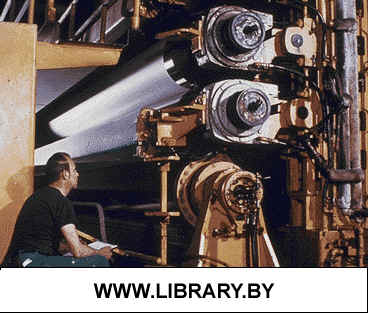
Paper products are third in value added. Paper products made in Wisconsin include typing
paper, cardboard boxes, tissue paper, paper bags, and adhesive tape. The leading
paper-manufacturing areas are the lower Fox River Valley and the upper Wisconsin River
Valley. Fort Howard Paper Company has its headquarters in Green Bay.
The production of electrical equipment is the fourth most important manufacturing activity
in Wisconsin. Chief electrical products include distributing equipment, household
appliances, industrial controls, and motors and generators. Johnson Controls, a leading
manufacturer of environmental controls for buildings, is based in Milwaukee. The
Appleton-Oshkosh and Racine areas are also centers of electrical equipment manufacture.
Fabricated metal products, including knives and hardware, metal cans, and metal forgings
and stampings, rank next in terms of value added. Many metal products are manufactured in
the Manitowoc, Milwaukee, and Racine areas.
Other types of products manufactured in Wisconsin,in order of value added, include printed
materials, transportation equipment, scientific instruments, and chemicals. The state's
major cities produce newspapers and large quantities of printed materials for businesses.
Motor vehicles and motor vehicle parts are the main types of transportation equipment made
in Wisconsin. Medical instruments and measuring devices are the chief types of scientific
instruments. Important chemical products made in the state include soaps, paints, and
pharmaceuticals.
Agriculture. Farms and pastures cover about half of Wisconsin's land area. The state has
about 80,000 farms.
Dairying is the most important type of farming in Wisconsin. The dairy industry started
about 1870. It was encouraged through the efforts of many people, especially William
Dempster Hoard. Hoard helped organize the Wisconsin Dairymen's Association in 1872. The
association did much to improve and promote Wisconsin dairy products. Later, it urged
farmers to work together and to market their products cooperatively. Today, about 500 farm
cooperatives have headquarters in Wisconsin (see COOPERATIVE).
Wisconsin ranks among the leading states in milk production. Milk provides more than half
the farm income. The state's largest concentration of dairy cattle is in the region
between Green Bay and Monroe. The region around Eau Claire also has many dairy farms.
Beef cattle and hogs rank as Wisconsin's second and third most valuable livestock
products, after milk. Southwestern Wisconsin has the largest concentration of cattle and
hog farms. The southeastern part of the state is the most important region for egg and
chicken farms.
Corn is Wisconsin's leading field crop. It is grown mostly in southern Wisconsin. Farmers
in all regions of the state raise hay. Corn is fed to hogs, and corn, hay, and oats are
fed to cattle. Other field crops raised in Wisconsin include barley, soybeans, tobacco,
and wheat.
Wisconsin is an important producer of vegetables and fruits. It leads the states in the
production of green peas, snap beans, and sweet corn. Wisconsin is also a chief producer
of beets, cabbages, cucumbers, lima beans, and potatoes. Most of the vegetables are sent
to canneries. Wisconsin ranks among the leading states in growing cranberries. The state's
farmers also raise apples, raspberries, strawberries, and other fruits.
Mining. Two mineral products, crushed stone and sand and gravel, account for most of
Wisconsin's mining income. Both of these products are used primarily in the construction
industry.
Electric power. Plants that burn coal provide about 70 percent of the electric power
generated in Wisconsin. Nuclear plants supply about 25 percent. Most of the remaining
power comes from hydroelectric plants. One of the first hydroelectric plants in the nation
was built in Appleton on the Fox River in 1882.
Transportation. Many of Wisconsin's first settlers traveled up the Mississippi River in
flat-bottomed boats called bateaux. Later settlers came by steamboat up the Mississippi
River, by ship on Lake Michigan, and overland by wagon. Mississippi River traffic declined
with the growth of railroads. Great Lakes transportation increased following the opening
of the St. Lawrence Seaway in 1959.
The first railroad in Wisconsin was opened in 1851. It ran between Milwaukee and Waukesha,
a distance of about 20 miles (32 kilometers). Today, six railroads provide freight service
in Wisconsin. Passenger trains serve about 10 cities.
Milwaukee has Wisconsin's busiest airport. Madison and Green Bay also have major airports.
Wisconsin has about 111,000 miles (179,000 kilometers) of roads and highways. In 1917,
Wisconsin became the first state to adopt the number system for highways. Other states
soon adopted the system.
Wisconsin's major ports are at Superior, Green Bay, and Milwaukee. Superior shares port
facilities with Duluth, Minnesota. Green Bay handles mostly U.S. cargo. International
cargo passes mainly through Milwaukee. A canal located at Sturgeon Bay links Green Bay and
Lake Michigan. An automobile ferry operates between Manitowoc and Ludington, Michigan.
Communication. Wisconsin's first newspaper, the Green-Bay Intelligencer, was founded in
1833. Today, Wisconsin publishers issue about 375 newspapers, of which about 35 are
dailies. Daily newspapers with the largest circulations include the Green Bay Press
Gazette, the Milwaukee Journal Sentinel, and the Wisconsin State Journal of Madison.
Wisconsin publishers also issue about 200 periodicals.
In 1853, the Wisconsin Press Association was founded. It was the nation's first state news
service. The association, now the Wisconsin Newspaper Association, collects and
distributes news among member newspapers. Its membership includes all of the state's daily
newspapers and about 220 weeklies.
The history of radio in Wisconsin dates from 1909. That year, University of Wisconsin
scientists conducted wireless experiments. The university radio station was licensed as
9XM in 1916, and the station became WHA in 1922. The state's first television station,
WTMJ-TV, started broadcasting from Milwaukee in 1947. Wisconsin now has about 280 radio
stations and 35 television stations. Cable TV systems serve many communities.
Government
Constitution. Wisconsin is still governed under its original Constitution, adopted in
1848. Only six other states are governed under older constitutions. An amendment to
Wisconsin's Constitution may be proposed in either house of the state Legislature. The
amendment then must be approved by a majority of each house in two successive legislative
sessions. Next, it must be ratified by a majority of the electors who vote on the
amendment in a statewide referendum. The Constitution may also be amended by a
constitutional convention. A proposal to call such a convention must be approved by a
majority of the Legislature and by a majority of the people voting on the proposal in a
statewide referendum.
Executive. The governor of Wisconsin holds office for a four-year term and can serve an
unlimited number of terms.
The lieutenant governor, secretary of state, attorney general, treasurer, and state
superintendent of public instruction are also elected by the people to serve four-year
terms. The governor of Wisconsin appoints numerous state officers who serve as members of
state boards and commissions.
Legislature consists of a Senate of 33 members and an Assembly of 99 members. Voters in
each of Wisconsin's 33 senatorial districts elect one senator to a four-year term. One
representative from each of 99 districts is elected to the Assembly to serve a two-year
term.
Regular sessions of the Legislature begin in January of odd-numbered years and meet for a
two-year period. The governor may call a special session at any time during the period.
There is no time limit on the legislative sessions. The governor may call special sessions
of the Legislature. Such sessions also have no time limit.
Courts. The highest court in Wisconsin is the state Supreme Court. It has seven justices,
elected to 10-year terms. The justice who has been on the court for the longest time
usually serves as the chief justice.
Other Wisconsin courts include an appellate court and circuit courts. The people elect the
judges of these courts to six-year terms. All Wisconsin judges are elected on nonpartisan
ballots (ballots without political party labels). A number of local governments also have
municipal courts.
Local government. Wisconsin has 72 counties. A board of elected supervisors governs each
county in the state. The supervisors select one of their members as chairperson. Other
elected county officials in Wisconsin include the sheriff, clerk, treasurer, register of
deeds, clerk of circuit court, and district attorney. Nine Wisconsin counties elect a
county executive.
Wisconsin law allows cities to operate under the mayor, manager, or commissioner form of
government. A few cities have the manager form. Most of them have the mayor-council form
of government. Elected boards of trustees govern Wisconsin's villages, and elected town
boards of supervisors govern its unincorporated areas.
Revenue. Taxes account for nearly 60 percent of the state government's general revenue
(income). Mostof the rest of the general revenue comes from United States government
grants and programs and state charges for goods and services. Revenue from taxes on motor
vehicle fuels and motor vehicle licenses go into special funds.
The individual income tax accounts for more than 45 percent and the general sales tax for
30 percent of all tax revenues. Other important sources of tax revenue include taxes on
corporate income, public utilities, and tobacco products.
Politics. The Democratic Party's strength is centered in Milwaukee, Madison, and other
urban areas. Republican strength lies mainly in rural and suburban areas.
Throughout most of its early history, Wisconsin strongly favored the Republican Party. In
fact, a meeting at a Ripon schoolhouse in 1854 contributed to the founding of the national
party. The Democratic Party gained strength in the 1950's and was the majority party from
the 1970's through the 1980's.
In presidential elections, Wisconsin has supported the Republican candidate about twice as
often as the Democratic candidate. In the 1924 presidential election, Wisconsin cast its
votes for a native son, Senator Robert M. La Follette, Sr., who ran unsuccessfully as a
Progressive. For the state's voting record in presidential elections since 1848.
History
Indian days. The Winnebago, Dakota, and Menominee Indians lived in the Wisconsin region
when the first white explorers came in the early 1600's. These Indians were skilled
craftworkers. They lived in lodges made of bark, saplings, and rushes. They fished and
hunted, and grew corn, beans, and squash. The Winnebago lived in the area between Green
Bay and Lake Winnebago. The Dakota lived in the northwestern part of the region. The
Menominee lived west and north of Green Bay.
Many other tribes moved into the Wisconsin area during the later 1600's. Some had been
driven from their eastern homes by white people. Others fled into the region to escape the
warring Iroquois League. The Chippewa came from the northeast and settled along the
southern shore of Lake Superior. Other tribes came from the Michigan region. The Sauk
settled west of Green Bay, the Fox along the Fox River, and the Ottawa along the southern
shore of Lake Superior. The Kickapoo settled in the south-central area, and the Huron in
the northwestern section. Bands of Miami and Illinois Indians spread along the upper Fox
River. The Potawatomi camped in what is now Door County.
Exploration and settlement. In 1634, the French explorer Jean Nicolet became the first
white person to set foot in the Wisconsin area. He landed on the shore of Green Bay while
seeking a water route to China. Nicolet stepped ashore wearing a colorful robe and firing
two pistols. According to tradition he was disappointed when Winnebago Indians, not
Chinese officials, greeted him. Nicolet returned to New France (Quebec) and reported that
America was far vaster than anyone had imagined.
About 25 years later, Pierre Esprit Radisson and Medard Chouart, Sieur des Groseilliers,
explored the Wisconsin area while searching for furs. The first missionary to the
Wisconsin Indians, Father Rene Menard, arrived about 1660. He established a Roman Catholic
mission near present-day Ashland. Father Claude Jean Allouez came to Wisconsin about 1665
and set up several missions. With the help of Father Louis Andre, he established a center
for missionary work on the site of present-day De Pere. Other French explorers and
missionaries who visited the area included Louis Jolliet, Father Jacques Marquette, and
Robert Cavelier, Sieur de La Salle.
Struggle for control. From the time of Nicolet's visit, the French had friendly relations
with most of the Wisconsin Indian tribes. But in 1712, a long war broke out between the
French and the Fox Indians. Both the French and the Fox wanted control of the Fox and
Wisconsin rivers, the region's chief water route. After many bloody battles, the French
finally defeated the Fox in 1740. But the long war had weakened France's defenses in the
region. France also lost the friendship of many former Indian allies.
In 1754, the French and Indian War began. This war was fought between Britain and France
over rival claims in America. Britain won the war. Under the terms of the 1763 Treaty of
Paris, France lost Canada and almost all its possessions east of the Mississippi River.
Control of the Wisconsin region thus passed to the British. See FRENCH AND INDIAN WARS
(The French and Indian War).
English fur traders took over the fur-trading posts of the French. In 1774, the British
passed the Quebec Act. Under this act, Wisconsin became part of the province of Quebec.
The Quebec Act was one of the causes of the revolt by the American colonies against
Britain in 1775. The 1783 Treaty of Paris ended the American Revolutionary War. Under the
treaty, Britain gave up all its territory east of the Mississippi and south of the Great
Lakes. The Wisconsin region then became part of the United States.
Territorial days. Wisconsin formed part of the Indiana Territory from 1800 to 1809, part
of the Illinois Territory from 1809 to 1818, and part of the Michigan Territory from 1818
to 1836. Settlement of southwestern Wisconsin began during the 1820's. This region had
rich deposits of lead ore. In the 1820's, the demand for lead for use in making paint and
shot rose sharply. Lead miners from nearby states and territories poured into the region,
and the population boomed. Some of the miners lived in shelters they dug out of the
hillsides. These miners were nicknamed Badgers, which, in time, became the nickname of all
Wisconsinites.
The Indians made their last stand in Wisconsin against white people in the Black Hawk War
of 1832. The Sauk Indians of northwestern Illinois had been pushed across the Mississippi
River into Iowa by the arrival of white settlers. Black Hawk, a Sauk leader, wanted to
return to his homeland and grow corn. In April 1832, he led a thousand Indians back across
the Mississippi. The white settlers panicked, and volunteer militia and regular troops
were called out. Black Hawk's Indians retreated into Wisconsin, where several bloody
battles were fought. When the war ended in August, only about 150 Indians were left.
On April 20, 1836, Congress created the Wisconsin Territory. The territorial legislature
met temporarily in Belmont and later in Burlington (now in Iowa). The first meeting in
Madison, the capital of the territory and later of the state, took place in 1838. The
Wisconsin Territory included parts of present-day Minnesota, Iowa, and North and South
Dakota. President Andrew Jackson appointed Henry Dodge as the first territorial governor.
Congress created the Iowa Territory in 1838. Wisconsin's western boundary then became the
Mississippi River, with a northward extension to Lake of the Woods in present-day
Minnesota. About a third of the present state of Minnesota remained part of Wisconsin
until 1848.
Statehood. Wisconsin joined the Union as the 30th state on May 29, 1848. Its boundaries
were set as they are today. The people had already approved a constitution. They elected
Nelson Dewey, a Democrat, as the first governor. In 1840, 30,945 white people lived in
Wisconsin. By 1850, the population had soared to 305,391. Newcomers came from other parts
of the United States and from other countries. All saw opportunities for a better life in
frontier Wisconsin.
In 1854, Wisconsin citizens became aroused over the introduction of the Kansas-Nebraska
Bill in Congress. This bill was designed to allow the new territories of Kansas and
Nebraska to decide for themselves whether they wished to permit slavery. Most
Wisconsinites opposed slavery and did not want it extended to new territories. A group of
Wisconsinites held a protest meeting against the bill in Ripon in February 1854. This
meeting contributed to the development of the Republican Party. See KANSAS-NEBRASKA ACT.
The Republican Party quickly became a powerful force in the North. Wisconsin's first
Republican governor, Coles Bashford, took office in 1856. For the next hundred years,
except for brief periods, the Republicans controlled the state government.
During the American Civil War (1861-1865), Wisconsin generals at various times commanded
the Iron Brigade, one of the Union Army's outstanding fighting groups. The brigade
consisted largely of Wisconsin regiments.
In 1871, Wisconsin was struck by the worst natural disaster in its history--the great
Peshtigo forest fire. The summer and fall of 1871 were extremely dry, and many small fires
broke out at various places in northeastern Wisconsin. Then, on the night of October 8,
northeastern Wisconsin erupted in flame. The fire wiped out the town of Peshtigo and
several villages. The fire also spread into Michigan. About 1,200 people were killed, 900
more than the number of people killed in the Great Chicago Fire, which occurred that same
night. The fire destroyed more than $5 million worth of property.
The Progressive era. During the 1890's, a split developed in the Republican Party in
Wisconsin. The party had been controlled by political bosses who represented lumber and
railroad interests. Robert M. La Follette, Sr., a Madison lawyer and former U.S.
congressman, began to lead a movement to overthrow the rule by bosses.
La Follette won the Wisconsin governorship in 1900. He was reelected in 1902 and 1904.
Under "Fighting Bob," the state made important social, political, and economic
reforms. La Follette's program was called Progressivism. La Follette set up a "brain
trust" of University of Wisconsin professors and experts on government to advise him
on state problems. The brain trust was part of the "Wisconsin Idea." This was
the theory that the state should be served by its best minds and its best experts in
legislation and administration. Measures adopted under La Follette included an inheritance
tax, a railroad property tax, regulation of railroad rates and service, and a direct
primary law (see PRIMARY ELECTION). La Follette entered the U.S. Senate in 1906 and served
there until 1925. See LA FOLLETTE (Robert Marion La Follette, Sr.).
In 1911, the Wisconsin legislature passed the Workmen's Compensation Act to protect
workers injured in accidents. That same year, the legislature established the Wisconsin
Industrial Commission to enforce industrial safety codes. Both measures were inspired by
Professor John R. Commons of the University of Wisconsin. Other progressive reforms
approved by the 1911 legislature included a state income tax law, the state life insurance
fund, and forest and waterpower conservation laws.
In 1924, La Follette ran for President as the Progressive Party candidate. President
Calvin Coolidge, a Republican, won the election. La Follette received the electoral votes
of only one state--Wisconsin. But he got almost 5 million popular votes. La Follette died
in 1925, and his eldest son, Robert, Jr., was elected to fill his Senate seat. Young La
Follette served in the Senate for 21 years.
The 1930's. In 1930, Philip F. La Follette, the youngest son of Robert M. La Follette,
Sr., was elected governor. La Follette, a Republican, lost the governorship in 1932. But
he was reelected in 1934 and 1936 as a Progressive. Much of the legislation enacted under
La Follette sought to relieve the suffering caused by the Great Depression of the 1930's.
In 1932, under his administration, the first state unemployment-compensation act was
passed.
In the spring of 1938, La Follette tried to organize a new national third party, the
National Progressives of America. But he won little support. The voters rejected La
Follette in 1938 and elected Julius P. Heil, a Republican, to the governorship of the
state. Heil worked to cut government costs. He did away with many agencies that La
Follette had set up while in office. Heil was reelected in 1940.
The mid-1900's. After World War II (1939-1945), Wisconsin agriculture, long the state's
top-ranking industry, began to decline in importance to the economy. At the same time, the
importance of manufacturing increased. Heavy beef imports from other countries, in
addition to low milk prices, hurt agriculture in the state. Changes in the American diet,
with emphasis on low-calorie foods, lowered the demand for dairy products. Between 1951
and 1969, the number of Wisconsin dairy farms fell from about 132,000 to 63,000. A number
of cheese factories, creameries, and other processing plants closed. Many small farms
merged, and the use of farm machinery increased. All these changes reduced the need for
farmworkers in Wisconsin, and the population began to shift from farms to cities.
In politics, La Follette Progressivism declined. After 21 years in the U.S. Senate, Robert
M. La Follette, Jr., lost the 1946 primary election to Republican Joseph R. McCarthy.
McCarthy won election to the Senate that year. He later became one of the most
controversial figures in American politics because of his unsupported charges that
Communists dominated the U.S. Department of State.
After 26 years of Republican or Progressive control of the state government, Democrat
Gaylord A. Nelson won the governorship in 1958. He was reelected in 1960. In 1962, Nelson
ran for the U.S. Senate and defeated Republican Alexander Wiley, who had been a senator
since 1939. Nelson won reelection to the senate in 1968 and in 1974.
In 1962, Wisconsin voters elected another Democratic governor, John W. Reynolds. But in
1964, they chose Republican Warren P. Knowles. Knowles was reelected in 1966 and 1968.
Also in 1964, the voters elected Bronson La Follette, grandson of Robert M. La Follette,
Sr., as state attorney general.
During the 1960's, Governors Nelson and Reynolds battled with the Republican-controlled
legislature over reapportionment (redivision) of the state's legislative and congressional
districts. The Wisconsin Constitution requires that the districts be redrawn every 10
years, if necessary, to provide fair representation. Both Nelson and Reynolds vetoed
reapportionment bills passed by the legislature. They said the bills did not make the
districts equal in terms of population. In 1963, the legislature passed a bill that
reapportioned the state's 10 congressional districts. Reynolds signed this bill, but he
and the legislature could not agree on a bill for the legislative districts. Finally, in
1964, the Wisconsin Supreme Court drew up a reapportionment plan. This was the first time
any state supreme court had reapportioned a state legislature. The court's plan went into
effect with the 1964 elections.
In 1969, the state assembly cut Governor Knowles's recommended welfare program for
Wisconsin's urban areas. A group of protesters occupied the assembly chamber for 11 hours
until they were removed by police.
The need for money to pay for education, public welfare, and other programs resulted in
state tax increases during the 1960's. The state legislature also passed a law, in 1961,
that established the first sales tax in Wisconsin's history. In 1963, the legislature
increased the number of items covered by the sales tax.
During the mid-1900's, Wisconsin expanded its educational facilities. Between 1956 and
1970, the University of Wisconsin opened 15 new branches throughout the state.
Recent developments. Officials of the University of Wisconsin tightened their control over
student activities in the 1970's. In 1969, following several student disorders on the
Madison campus, the state legislature passed laws to control such disturbances. These laws
established fines and imprisonment for campus misconduct. In 1971, the state legislature
merged the University of Wisconsin and Wisconsin State University to form a state
university system called the University of Wisconsin System.
In 1987, Wisconsin adopted a state lottery as a means of increasing government revenues.
Manufacturing, with the help of the Wisconsin Department of Development, remains strong in
the state in the 1990's. But agriculture continues to be vital to the economy of
Wisconsin. Although dairying still provides the most agricultural income, income from
crops is increasing. However, farms in Wisconsin continue to decrease in number and
increase in size.
Wisconsin faces a number of other challenges in the 1990's. These problems include
increasing costs for education, welfare, control of water pollution, and the purchase of
land for recreational purposes. The state is also concerned with problems related to
agriculture, such as the huge debt of its farmers.
Contributor: Benjamin D. Rhodes, Ph.D., Prof. of History, Univ. of
Wisconsin, Whitewater. Gary C. Meyer, Ph.D., Prof. of Geography and Natural Resources,
Univ. of Wisconsin, Stevens Point.
Questions
What was the greatest natural disaster in Wisconsin's history?
How many state constitutions has Wisconsin had in its history?
What portion of the cheese made in the United States does Wisconsin produce?
How did Wisconsin receive the nickname the Badger State?
What role did glaciers play in shaping Wisconsin's surface features?
What was the "Wisconsin Idea"?
Why was Jean Nicolet disappointed when he landed on the Green Bay shore in 1634?
What role did Mrs. Carl Schurz play in the history of education?
What are some of the reforms Wisconsin began that other states later adopted?
What are Devil's Elbow, Grand Piano, and Fat Man's Misery?
Additional resources
Level I
Bratvold, Gretchen. Wisconsin. Lerner, 1991.
Carpenter, Allan. Wisconsin. Rev. ed. Childrens Pr., 1978.
Stein, R. Conrad. Wisconsin. Childrens Pr., 1987.
Thompson, Kathleen. Wisconsin. Raintree, 1986.
Level II
Current, Richard N. Wisconsin: A Bicentennial History. Norton, 1977.
Mason, Carol I. Introduction to Wisconsin Indians: Prehistory to Statehood. Sheffield Pub.
Co., 1988.
Nesbit, Robert C. Wisconsin: A History. 2nd. ed. Univ. of Wisconsin Pr., 1989.
Rippley, La Vern J. The Immigrant Experience in Wisconsin. Twayne, 1985.
Schultz, Gwen M. Wisconsin's Foundations: A Review of the State's Geology and Its
Influence on Geography and Human Activity. Kendall-Hunt, 1986.
Thelen, David P. Robert M. La Follette and the Insurgent Spirit. Univ. of Wisconsin Pr.,
1986. First published in 1976.
Vogeler, Ingolf, and others. Wisconsin: A Geography. Westview, 1986.
Wisconsin in Brief
Source: U.S. Bureau of the Census.
General Information
Statehood: May 29, 1848, the 30th state.
State Abbreviations: Wis. (traditional); WI (postal).
State Capital: Madison, Wisconsin's capital since 1848. Territorial capitals were Belmont
(1836), Burlington, now in Iowa (1837-1838), and Madison (1838-1848).
State Motto: Forward.
Popular Name: The Badger State.
State Song: "On, Wisconsin!" Words by J. S. Hubbard and Charles D. Rosa; music
by William T. Purdy.
Symbols of Wisconsin
State Bird: Robin.
State Flower: Wood violet.
State Tree: Sugar maple.
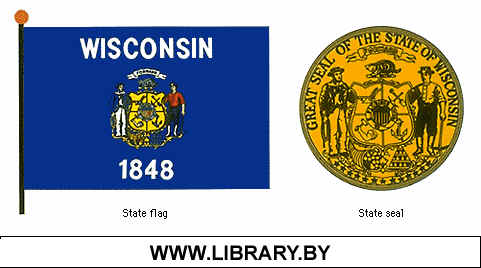
State Flag and Seal: The state flag, adopted in 1913, bears the state seal. The name
Wisconsin and the year it became a state, 1848, were added in 1981. On the state seal,
adopted in 1881, a sailor and a miner support a shield with symbols of agriculture,
mining, navigation, and manufacturing. A small United States coat of arms symbolizes
Wisconsin's loyalty to the Union. The badger above the shield represents Wisconsin's
nickname--the Badger State.
Land and Climate
Area: 56,145 sq. mi. (145,414 sq. km), including 1,831 sq. mi. (4,741 sq. km) of inland
water but excluding 9,355 sq. mi. (24,229 sq. km) of Great Lakes water.
Elevation: Highest --Timms Hill, 1,952 ft. (595 m) above sea level. Lowest --581 ft. (177
m) above sea level along the shore of Lake Michigan.
Record High Temperature: 114 degrees F (46 degrees C) at Wisconsin Dells on July 13, 1936.
Record Low Temperature: -54 degrees F (-48 degrees C) at Danbury on Jan. 24, 1922.
Average July Temperature: 70 degrees F (21 degrees C).
Average January Temperature: 14 degrees F (-10 degrees C).
Average Yearly Precipitation: 31 in. (79 cm).
People
Population: 4,906,745 (1990 census).
Rank Among the States: 16th.
Density: 87 persons per sq. mi. (34 per sq. km), U.S. average 69 per sq. mi. (27 per sq.
km).
Distribution: 66 percent urban, 34 percent rural.
Largest Cities in Wisconsin: Milwaukee (628,088); Madison (191,262); Green Bay (96,466);
Racine (84,298); Kenosha (80,352); Appleton (65,695).
Economy
Chief Products
Agriculture: milk.
Manufacturing: machinery, food products, paper products, electrical equipment, fabricated
metal products.
Mining: crushed stone, sand and gravel.
Government
State Government
Governor: 4-year term.
State Senators: 33; 4-year terms.
State Representatives: 99; 2-year terms.
Counties: 72.
Federal Government
United States Senators: 2.
United States Representatives: 9.
Electoral Votes: 11.
Sources of Information
For information about tourism in Wisconsin, write to: Wisconsin Division of Tourism, 123
West Washington Avenue, P. O. Box 7970, Madison, WI 53707. The Office of the Governor
handles requests for information about the state's economy, government, or history. Write
to: Office of the Governor, State Capitol, Box 7863, Madison, WI 53707.
Interesting facts about
Wisconsin
The first practical typewriter was invented by Christopher Latham Sholes, with the help of
Carlos Glidden and Samuel W. Soule, in Milwaukee in 1867.
The first kindergarten in the United States was opened in 1856 in Watertown by Mrs. Carl
Schurz. Schurz had been a pupil of Friedrich Frobel, the father of the kindergarten
movement, who started his first kindergarten in Germany in 1837.
The world's first plant to produce electricity from water power began operating in
Appleton in 1882. The plant was built on the Fox River.
Malted milk was invented by William Horlick in 1887 in Racine.
The first woman commissioned by Congress to create a work of sculpture was Vinnie Ream of
Madison. She was commissioned in 1866 to produce a statue of Abraham Lincoln when she was
only 18 years old. The statue, completed in 1870, stands in the U.S. Capitol. |


